| My Work Areas: |
(my wrapping stand
work area)
|
(my woodwork area)
|
(my lacquering
workshop)
|
(my den / study area)
|
|
|
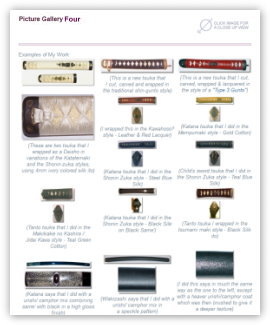
Examples of My Work:
|

(a Showa-to tachi that I rewrapped
and lacquered)
|

(I wrapped this in the Kawahoso?
style - Leather & Red Lacquer)
|

(Katana tsuka that I did in the
Mempumaki style - Gold Cotton)
|
(Handachi Tsuka)
|

(Katana tsuka that I did in the
Shonin Zuka style - Steel Blue Silk)
|

(Child's sword tsuka that I did in the
Shonin Zuka style - Teal Blue Silk)
|

(Tanto tsuka that I did in the
Makikake no Kashira /
Jidai Kawa style - Teal Green Cotton)
|

(Katana tsuka that I did in the
Shonin Zuka style - Black Silk
on Black Same')
|

(Tanto tsuka I wrapped in the tsumami
maki style - Black Silk ito)
|

(Katana saya that I did with a
urishi/ camphor mix combining same'
with black in a high gloss finish)
|

(Wakizashi saya that I did with a
urishi/ camphor mix in
a speckle pattern)
|
(I did this saya in much the same way as
the one to the left, except with a heaver
urishi/camphor coat which was then brushed to give it a deeper
texture)
|

(To obtain this texture, with
the cloud pattern, I have tried many different techniques
with mixed results. On this saya, after laying the base coats,
I traced the design in wax before applying the top coats.
I then retraced the lines witha metal pick and wet/dry sanded
the surfaceto give it a more even texture)
|
(I did this saya in much the same way as
the one to the left, except with heaver
urishi/camphor coats, and an application of hot wax on the design
between each coat. I finished in the same way, by wet/dry sanding
the surface to give it a more even texture)
|

(Katana saya that I did with a
urishi/ camphor mix with
a high gloss finish)
|
(On this saya I used a togidashi
maki technique, combining urishi with
ground mother of pearl and, to enhance the greenish cast, aokin)
|
(This is a saya that I did in much the
same manner as the one to the left,
with the addition of overlaid
urishi/camphor rings)
|
(Again, on this saya I used a togidashi
maki technique, except that I used
chopped straw, a.k.a. dried lawn mower
clippings, in place of mother of pearl)
|
| Other Projects: |
|
|
(This was an older 27.5" blade in
Gunto mounts that I made a new saya
& tsuka for incorporating an old
set of
nanako fuchi/ka, old bird menuki,
and a larger open work tsuba;
I finished the saya in a urishi/
camphor mix in a speckle pattern)
|
|
(This is an unsolicited video sent to
me from the Twin
Cities Budokan showing Sensei Al Kilgore in action
while using a couple of blades
that I rebuilt the mounts for.)
|

(This is an example of a used 14"
Cheness
Cutlery Oniyuri Tsuka
with flat black fittings, and cotton
ito. Note the looseness of the wrap
and the lack of hishigami, or paper wedges, on the original.
Following the client's instructions
sent to me with the handle, I
rewrapped it in the katatemaki
style, using burgundy silk ito and
new menuki.)
|
(Above are two examples of Paul
Chen Shinto blades, originally in shirasaya,
and purchased from Swords
of Might. I remounted them using parts and
materials from various sources. For example, the menuki fuchi
and kashira on the
sword to the left are from Cheness, whereas the fuchi and kashira
on the right
come from Fred
Lohman. The tsuba on both are original Japanese pieces.
Also, I cut both tsuka, and the saya on the left, from honoki,
the saya on the
right is made of teak wood. These Shinto blades exhibit great
fumbari.)
|

(These are tsuka from inexpensive
Japanese alloy iai-to that were
purchased from the Asian
World of Martial Arts by a 13 year old practitioner, and
a 15 year
old practitioner.)
 
(Following thier
instructions, I rewrapped one
in a variation of the Shonin Zuka
style using green silk ito, and the
other in the katatemaki style, using
gold silk ito. Note on both originals
the wrap
was loose , they lacked hishigami,
or paper wedges, and
the menuki were placed upside
down and backwards.)
|